
Citizen engagement: from promise to practice
-
Chapter 1: Introduction2 Paragrafen
-
Chapter 2: Start with the right questions5 Paragrafen
-
Chapter 3: Designing the participation process6 Paragrafen
-
Chapter 4: Making participation succeed6 Paragrafen
-
Chapter 5: Understanding the impact of participation4 Paragrafen
-
Chapter 6: Skills, capacity, policies and governance needed4 Paragrafen
-
Chapter 7: Final thoughts1 Paragraaf
3.4: Collaborate with citizens
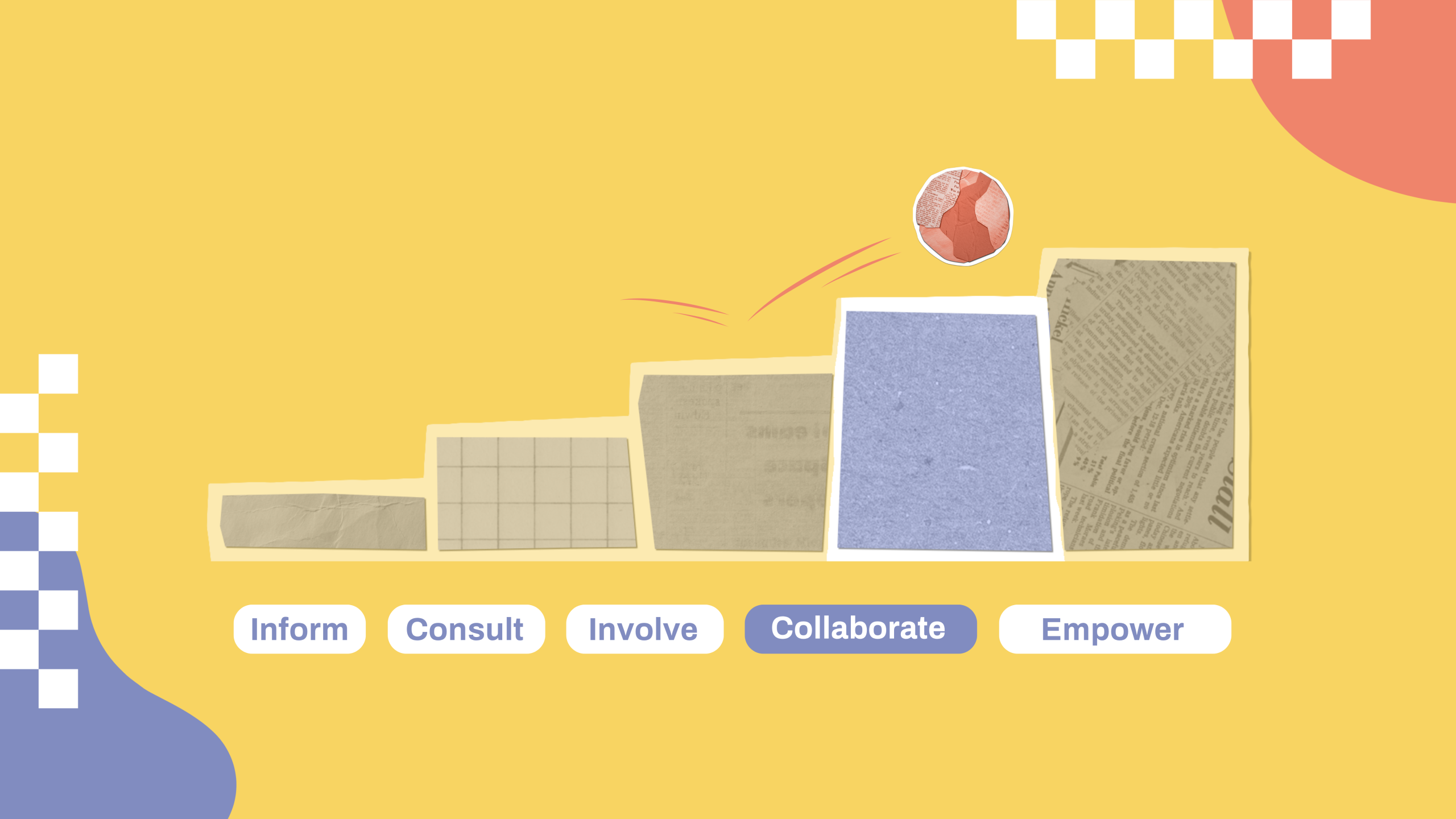
At this level, the process becomes more shared. Citizens and public authorities work side by side, combining different forms of knowledge and responsibility to develop solutions together.

What's the main purpose?
Citizens, stakeholders and public authorities share responsibility for developing solutions together.
What can you do?
Collaboration allows you to develop solutions together with citizens and stakeholders, bringing different forms of knowledge and experience into a single process. It helps you clarify trade-offs and possible choices collectively, and to build shared ownership around a project or policy. Collaboration also makes it possible to involve citizens and stakeholders in follow-up or implementation, and to create meaningful partnerships between government, civil society, experts and communities.
Why it matters?
Collaboration can create stronger and more realistic solutions, because it brings together people who understand the issue from different angles.
When done well, collaboration builds trust, shared ownership and commitment. It helps move participation from “asking citizens what they think” to “working together on what needs to happen.”
Your promise to citizens:
“We will work together to develop solutions and incorporate this in decisions as much as possible. Although Public authorities still remain accountable for the final decision, but the process is built around shared responsibility.”
Lessons from the field
In this video, Signe (Skive) and Rachel (county of Agder) reflect on their citizen collaboration initiatives, the challenges they faced, and the lessons they learned.

Climate Villages - Municipality of Skive
Discover how Skive's Climate Villages are turning local communities into testing grounds for citizen-driven climate action.
Citizens' Council on Mobility - City of Roeselare
Learn how Roeselare's citizens' council shaped recommendations for the city's new mobility plan.
District Councils (Bydelsrådene) - Kristiansand
Discover how Kristiansand's neighbourhood councils are giving residents a structured voice in local decision-making.
Citizen Assembly on Waste - City of Groningen
Learn how Groningen's citizens' assembly shaped practical policy actions for reducing waste to zero by 2030.

Which concrete methods could you use?
- Co-creation labs or policy labs;
- Multi-stakeholder working groups;
- Citizens’ assemblies with a strong advisory role;
- Joint committees with citizens and officials.
Co-creation & Collective Impact
In this video, Cynthia (Hannah Arendt Instituut, Belgium) and (VIA University College, Denmark) share key insights on collaborative governance, from the Collective Impact model to the changing role of public servants in co-creation.
The Collective Impact Model
Framework for real collaboration
The Collective Impact model offers organisations and local governments a framework for collaborating with citizens, organisations and stakeholders around a shared agenda to achieve societal change. It provides concrete tools and building blocks for setting up and structuring collaborative partnerships, so that change comes about not through the efforts of a single party, but through joint action and shared responsibility.
Building on this framework, the Hannah Arendt Institute wrote a report on how local governments are seeking to integrate elements of Collective Impact into their day-to-day functioning, in order to organise genuine collaboration with citizens and relevant stakeholders.