Engagement citoyen : de la promesse à la pratique
-
Chapitre 1 : Introduction2 Paragraphes
-
Chapitre 2 : Commencez par poser les bonnes questions5 Paragraphes
-
Chapitre 3 : Concevoir le processus de participation6 Paragraphes
-
Chapitre 4 : Réussir la participation6 Paragraphes
-
Chapitre 5 : Comprendre l'impact de la participation4 Paragraphes
-
Chapitre 6 : Compétences, capacités, politiques et gouvernance nécessaires4 Paragraphes
-
Chapitre 7 : Réflexions finales1 paragraphe
2.1 : Quelle est notre raison d'être ?
Before engaging citizens, get clear on the purpose: why you’re doing it, what exactly you’re asking of them, and what you can realistically do with what they contribute.
Step 1: Choose an issue people can connect to
Engagement works best when the issue is clear, concrete, and relevant to daily life. Big ambitions feel important, but are harder to translate into clear input or action. Starting smaller and more practical makes it easier for people to join, and to see why their participation matters.
People often engage when a topic connects to what they care about: their identity, their community, their children, their future, or their sense of belonging. In Skive, the climate villages showed how a climate project can also become a community project. People took part not only because they wanted to reduce emissions. They also cared about creating places to meet, strengthening local pride, and making everyday life better.
Signe, de Skive
Step 2: Be clear about why you want to involve citizens
Once you’ve chosen an issue, be clear about why you’re involving citizens: to share experiences, define priorities, test ideas, co-develop solutions, or make decisions? The reason matters, since it shapes expectations. Don’t involve citizens because it’s expected; involve them because their knowledge, experience, or perspective can improve the process, decision, or outcome.
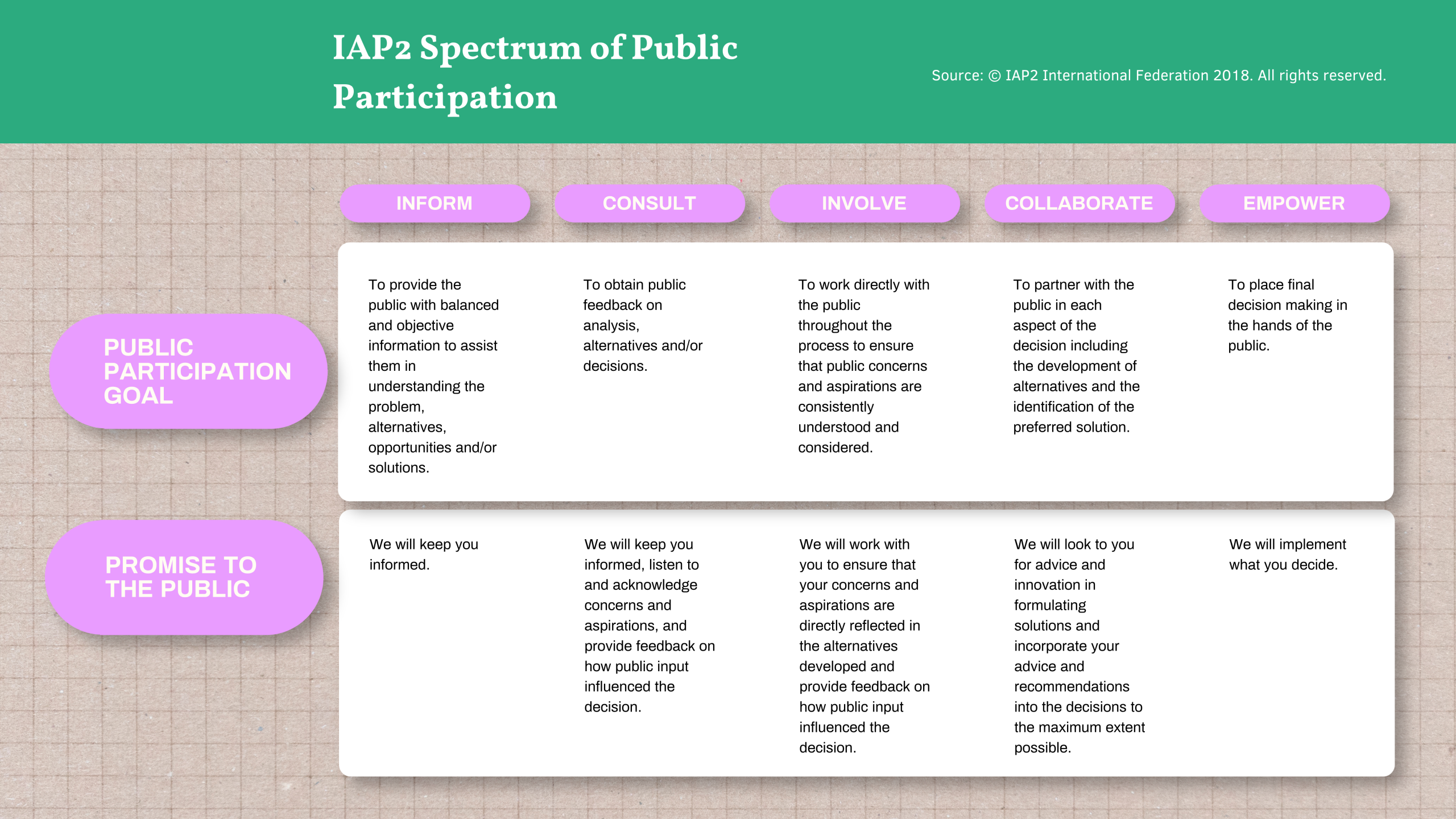
The Spectrum of Public Participation helps you match your goal to the right format. Take a look below!
Being clear about the reasons for involving citizens also helps your organisation choose the right participation format. For further insight into designing the participation process, go to Chapitre 3 : Concevoir le processus de participation.
Step 3: Be clear about what people can influence
People deserve to know how much influence they have before they invest their time. Being honest about this protects the credibility of the process. It also reduces the risk of disappointment when some ideas cannot be taken forward.
The Spectrum of Public Participation also helps you define how much influence people really get. Take a look below!
Political limits
Who takes the final decision? Some decisions may remain with elected officials, a council, or senior leadership.

Legal limits
What laws and regulations must be followed? Some options may not be legally possible.

Procedural limits
Which decision-making timelines are already fixed? The process may need to fit existing procedures.
Financial limits
What budget is available? Some ideas may be valuable but too costly to implement.
Practical limits
What can realistically be delivered with the available time and resources?
Implementation limits
Who will carry out the results, and when? Some proposals may require long-term follow-up.
In Skive, the climate villages had space to develop their own ideas, but final approval still stayed with the municipality. Programme descriptions, goals and budgets all had to fit within formal municipal procedures. Citizens need to know from the start what they can decide themselves, and where legal, administrative or budgetary limits still apply.
Signe, de Skive
Introducing the engagement ladder
How much say do citizens really have? Tricky question. That’s where the engagement ladder comes in: a simple way to show participation isn’t one-size-fits-all. The idea goes back to Sherry Arnstein’s 1969 Ladder of Citizen Participation, which was one of the first to point out that different types of engagement give people different amounts of power. In this e-learning, we use a more recent, practical version of that idea: the IAP2 Spectrum of Public Participation. It helps you pick the right level of engagement, and make a clear promise to citizens.
For further insight into the engagement ladder, go to Chapitre 3 : Concevoir le processus de participation.